Language / Taal / Sprache / Langue

Padstow St Issey St Breock Downs Lanivet Helman Tor Luxulyan Fowey Looe St Germans St Ervan St. Mawgan Newquay Holywell Bay St Pirans's Cross St Agnes North Cliffs Lelant Ludgvan St. Michael's Mount Truro

Discover the Way

This route follows ancient paths across Cornwall shaped by ancient saints, farmers and merchants, tidal islands, coastal paths and quiet inland valleys. Churches and chapels, holy wells and long-forgotten field paths, the untouched nature and wild coastline, they all reveal a fragment of Cornwall’s spiritual, cultural and natural heritage.

It invites you to slow down, notice the landscape and travel with intention. You follow in the footsteps of Celtic saints and pilgrims who shared ideas and carried traditions that still echo today.

Whether you explore a single stretch or the entire route, the Cornish Celtic Way encourages reflection, curiosity and a sense of connection with people who travelled long before us. Above all, it is an invitation: to walk, to wonder and to discover Cornwall in a new way.

The freedom of ancient paths

The United Kingdom holds one of the richest networks of historic walking routes in Europe. Many of these paths still follow tracks that have been used for centuries by pilgrims, traders, herders and travellers alike.

What makes the United Kingdom United Kingdom particularly distinctive is not only the antiquity of these routes, but the fact that many of them are legally protected as public rights of way. As a result, thousands of miles of historic pathways have remained open and accessible to walkers. In many other European countries, by contrast, ancient paths have disappeared or become fragmented through privatisation, agricultural consolidation or large-scale infrastructure development.
Why these paths survived

The system of rights of way is a key reason why so many of these historic routes still exist and remain walkable today. But what does it actually mean? A public right of way is a legally protected entitlement for the public to pass along a specific route, even when it crosses private land, fields or farmland. The land remains privately owned, but the right of passage cannot be blocked or removed by the landowner.

In many cases, these rights are rooted in centuries of continuous use. When villagers, pilgrims, herders or traders used a path across generations, it could gradually become recognised as an official public thoroughfare. In this way, through what evolved in English legal tradition as common law, a network of routes emerged that long pre-dated modern infrastructure. These paths connected villages and hamlets, churches and market towns, ports and pilgrimage destinations.

When large parts of the countryside were enclosed during the 18th and 19th centuries through the Enclosure Acts, many ancient routes disappeared. Yet thanks to local resistance and later legislation, a significant portion of this historic network survived. Today, this legacy is still visible in Public Bridleways, open to walkers, horse riders and cyclists, and Public Footpaths, reserved for walkers only.

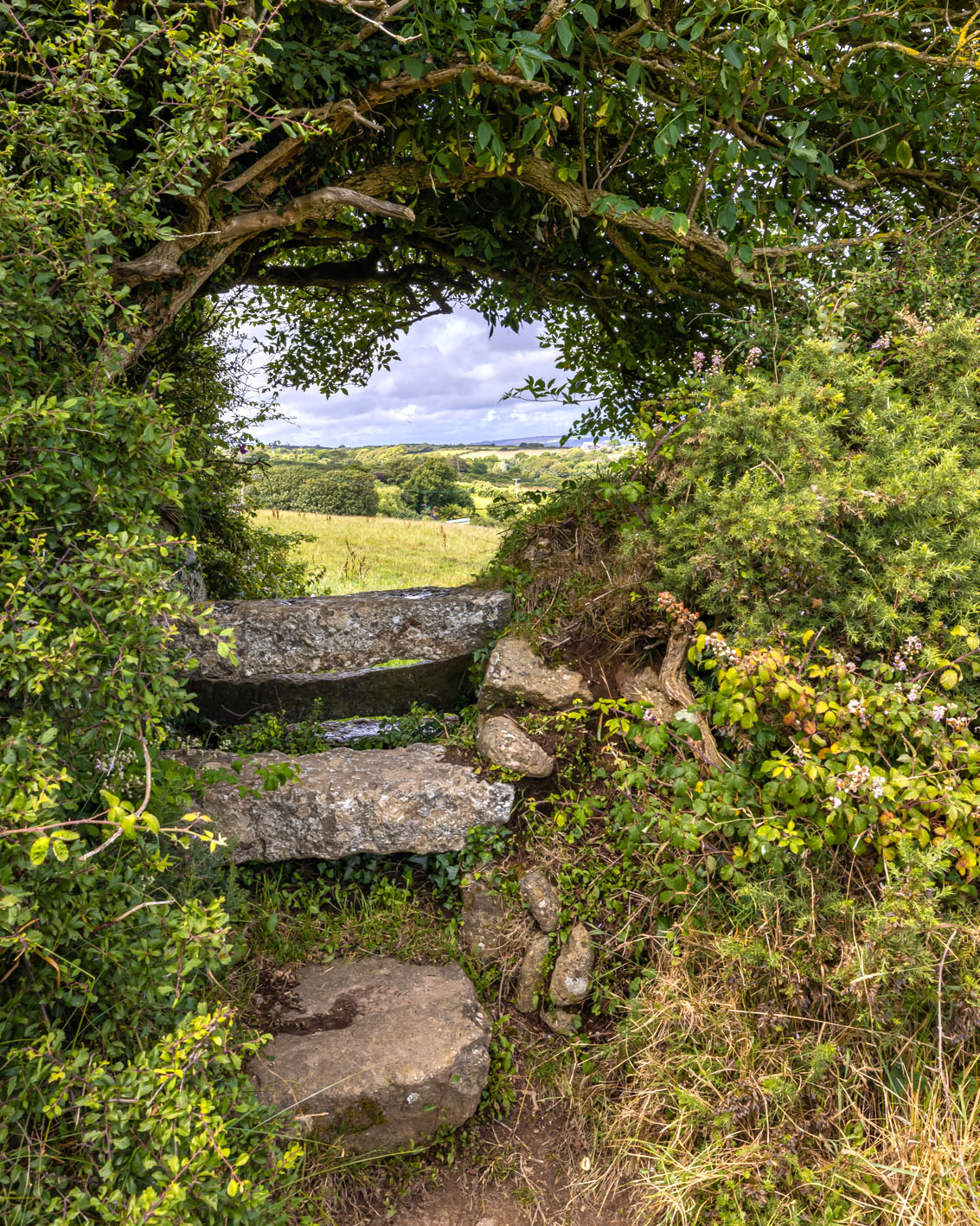
While walking the Cornish Celtic Way, I gratefully made use of these beautiful and quiet paths

Quiet rituals of walking

A public right of way grants freedom, but it also invites a sense of responsibility and care. Those who walk these ancient paths are expected to stay on the designated route, respect the character of each path, and keep dogs on a lead, especially near livestock. Gates and stiles are closed after passing through, crops and farmland are respected, and everything carried along is taken back again. Yet these simple gestures mean more than practical responsibility. 

For many walkers, whether pilgrims or not, these simple gestures become a familiar quiet ritual along the way. Opening and closing a gate, crossing a stile, or entering and leaving a field marks a small transition: a moment of awareness between one place and the next. Step by step, these small acts make a long journey feel possible: a path too vast to grasp all at once becomes a succession of smaller sections, each one marked by its own thresholds, encounters and discoveries.