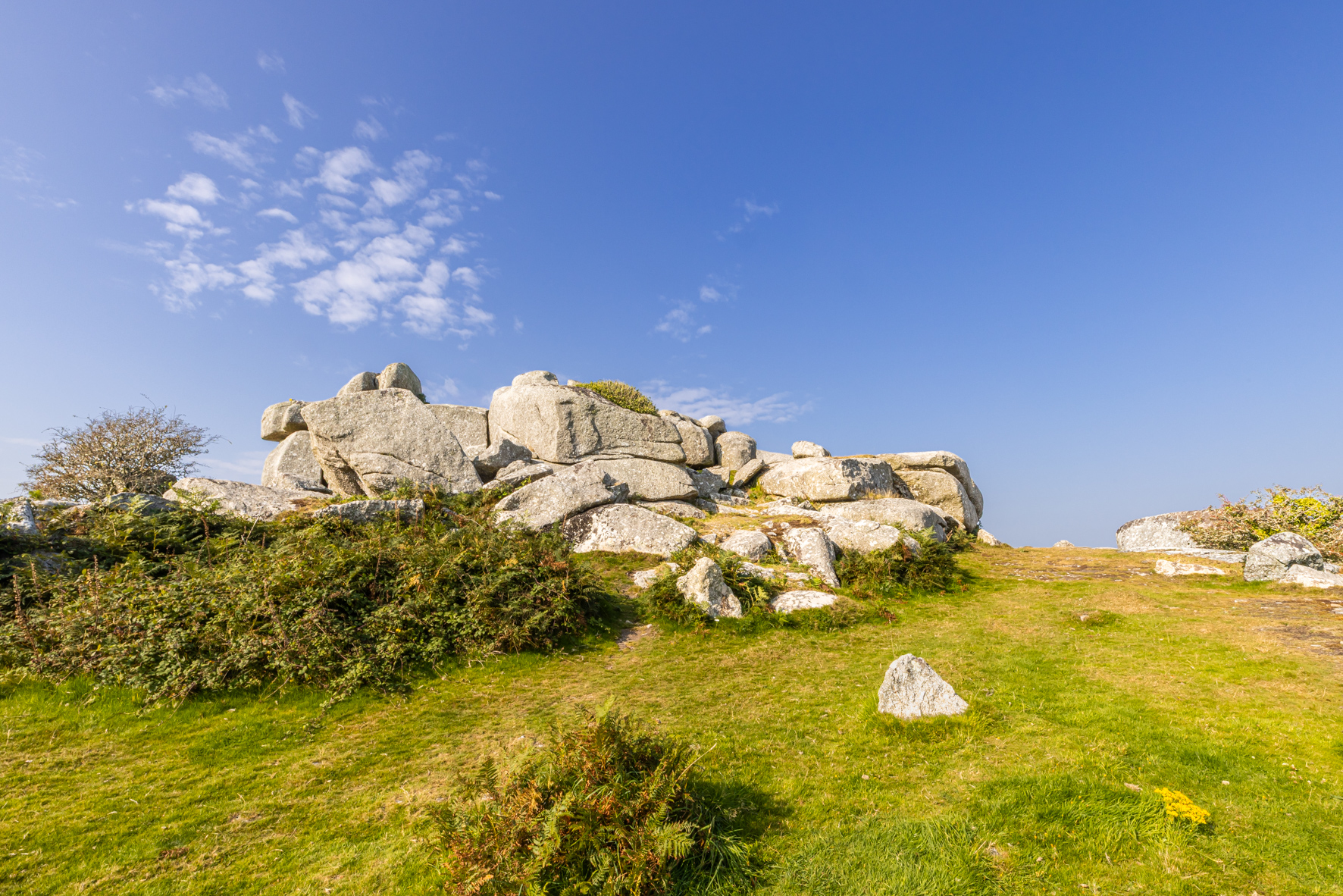
Helman Tor, where granite and history come together
From afar, Helman Tor catches the eye of those walking the Saints’ Way. This striking granite tor, a hill whose summit is crowned by a free-standing rock formation, rises around 209 metres above the surrounding landscape and has watched over central Cornwall for centuries as a natural viewpoint. Those who make the short climb to its summit are rewarded with wide views across woodlands, heathland and rolling fields, a landscape that invites visitors to pause for a moment and quietly take in their surroundings.
Yet Helman Tor is much more than a scenic viewpoint. The hill tells a story that reaches back hundreds of millions of years. Its granite was formed deep beneath the Earth’s crust during the geological formation of South West England. Much later, wind, rain and frost gradually wore away the softer rocks, leaving the harder granite mass standing above the landscape as a natural tor. At the summit lie several large granite boulders, including so-called logan stones: heavy stones that can sometimes be moved slightly when touched at the right point.
Archaeologists have discovered remains of ancient enclosures, dwellings and field systems dating from the Neolithic period and the Bronze Age. This makes Helman Tor one of Cornwall’s oldest inhabited landscapes. Today, it forms part of an extensive nature reserve where heathland, wetlands and ancient woodland meet. For walkers following the Saints’ Way, it is easy to imagine that generations before us have looked out over this very same landscape.