St Breock Downs

The Great Stone of St Breock Downs

On the high plateau, where the wind roams freely and the view stretches for miles, stands a giant of granite: the St Breock Downs Monolith, also known as Men Gurta, the stone of meeting. Nearly five metres tall and weighing sixteen tons, it is the largest standing stone in Cornwall.

Anyone who comes here immediately senses that this is no mere fragment of nature, but a monument shaped by human hands, set in place thousands of years ago. It dates back to the late Neolithic or early Bronze Age (2500–1500 BC), a time when the landscape was still a sacred book in which people sought to read the sun, the seasons, and the gods. For me, it becomes a symbol of endurance, of steadfastness, of holding one’s place even as the storms rage.

The Wind as a Travelling Companion

In Cornwall, the wind is an invisible travelling companion, almost always present. You notice it the moment you set foot on the peninsula: a narrow stretch of land reaching out into the sea, open on three sides.

Sometimes it is no more than a gentle breeze brushing across hedgerows and stone walls. At other times, a strong westerly seems almost to push you forward along the cliffs. Yet it rarely feels harsh or oppressive. The air is constantly in motion, as though the landscape is quietly breathing.

Anyone following the South West Coast Path soon discovers that walking here is an ongoing conversation with the elements. High on the cliffs, the wind can suddenly gather strength. Never threatening, but always making its presence felt.

And that is precisely what makes walking here so special. The wind clears the air, drives clouds across the sky in ever-changing formations, sets the waves in motion and gives the landscape a different light from one moment to the next.

After a while, the wind becomes something familiar. It seems to loosen your thoughts, clear your mind and gently draw you into the rhythm of the landscape.
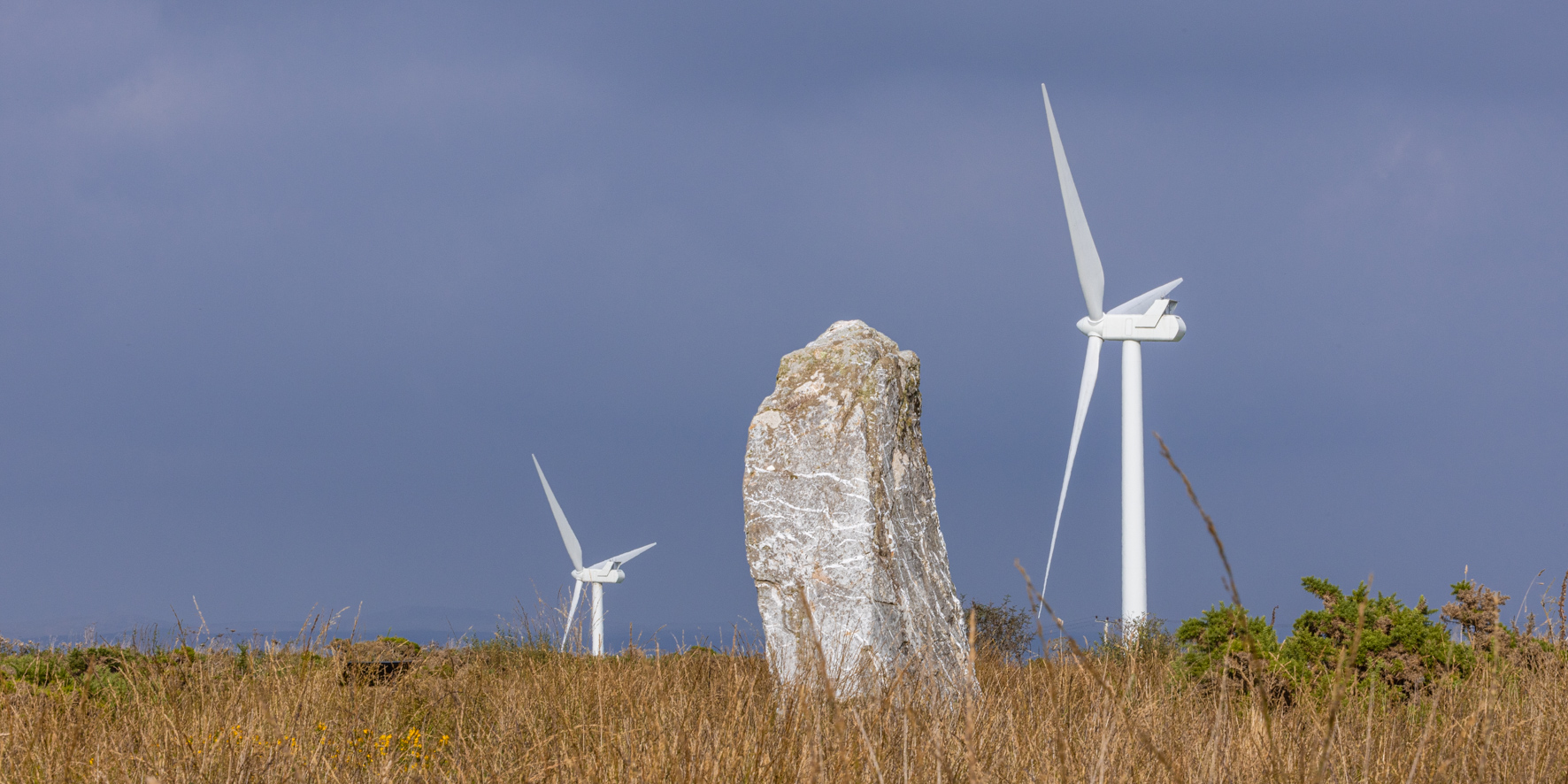
 

Guardian of the Winds

Was the monolith a sacred place where rituals and gatherings were held? Perhaps it also played a role in tracking the sun and the changing seasons, as other prehistoric monuments are thought to have done.

No one can say for certain. It is just as likely that it served as a landmark or boundary marker on the open landscape of the Downs. Whatever its original purpose, it remains a witness, a silent guardian.

The Same Wind

There is certainly no shortage of wind on this high plateau. A little further on, the very same wind now turns the blades of a modern wind farm, its turbines rotating rhythmically behind the monolith.

At first glance, it seems a striking contrast: a prehistoric stone with modern wind turbines rising beyond it, harnessing the same force of nature to generate electricity. Yet perhaps they are not as different as they appear.

The wind has always been here. Only the way people relate to it has changed. Thousands of years ago, people may have come to this place in search of meaning in the sun, the seasons and the forces of nature. Today, that very same natural force is transformed into renewable energy.